
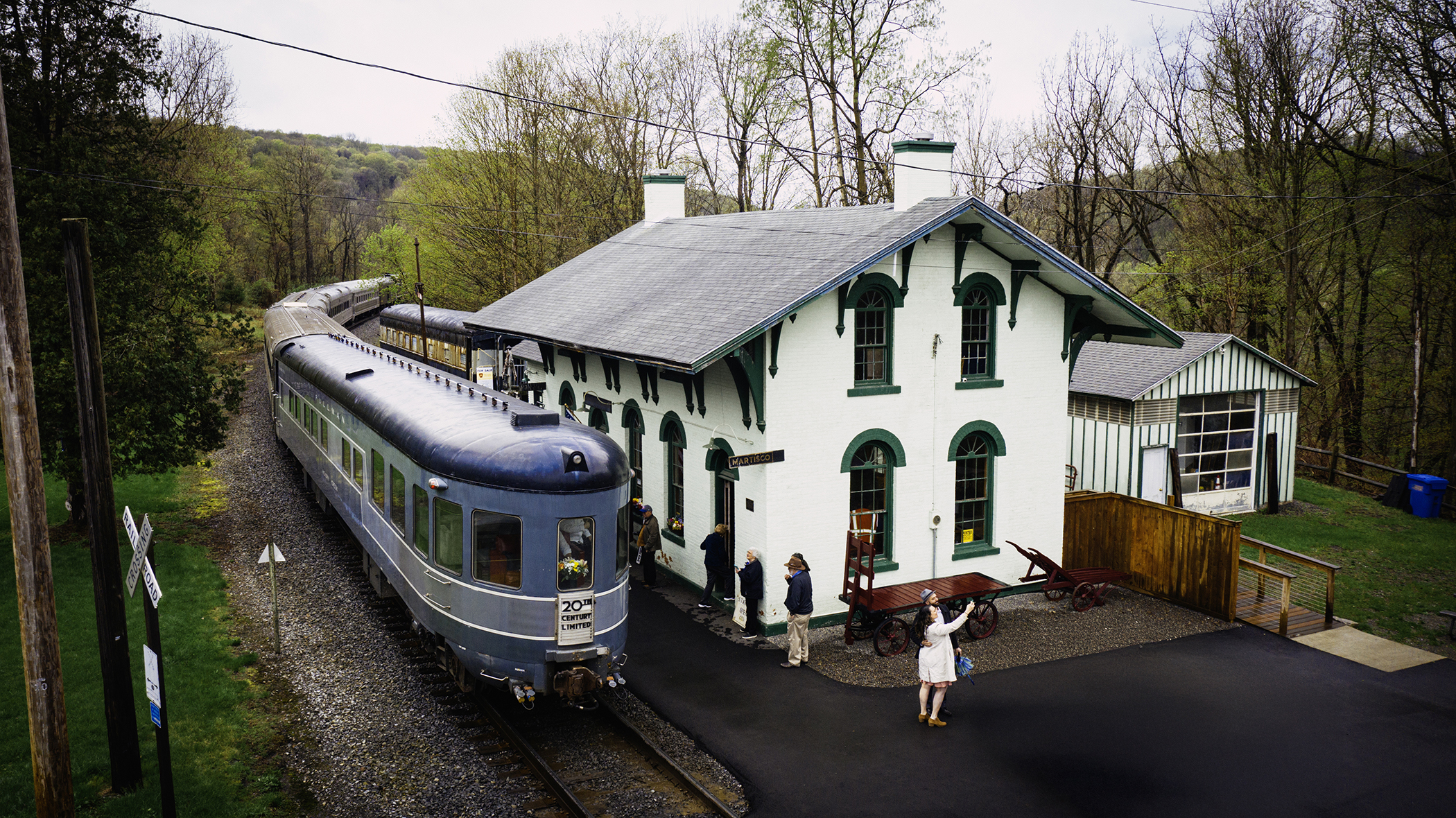
After a long absence, railroad tourism returns to the Finger Lakes region of New York State in less than 60 days
There’s an old joke in the rail industry, and we all know it: to make a small fortune in the tourist rail business, you start with a large one. FMW Solutions has spent the past decade proving otherwise: that knowledge, relationships, and a relentless work ethic can still turn modest beginnings into meaningful success.
This approach to rail tourism is best embodied by FMW’s work over the last 12 months in upstate New York. When the Class 3 short line Finger Lakes Railway (FGLK), decided to end its own passenger train operations in 2024, it did not want to exit that space fully. Instead, FGLK management sought to revive passenger excursions on its network in upstate New York by bringing in a tourist rail partner to reinvent the operation. It required a collaborator who could plan, brand, market, and operate a full-fledged tourist railroad in record time. The result was the Finger Lakes Rail Experience, a thirteen-week whirlwind startup developed, funded, and operated by FMW that drew more than 12,000 passengers in its first season and demonstrated how small freight railroads can power big tourism.
From Concept to First Class
FMW Solutions has long been known for its mechanical and engineering work. Much of the public attention naturally goes to the company’s restoration and preservation projects — because big steam motive power tends to steal the spotlight, both literally and figuratively. Whether it’s completing the entire running gear rebuild of No. 1225 or returning operational steam to the Hawaiian Islands for the first time in decades, steam projects tend to attract the most buzz about FMW.
But today, FMW’s portfolio extends well beyond wrenches and welders. The company operates across nearly every facet of the rail industry. Their team of more than 40 full and part-time employees tackles work spanning alternative energy development (battery and hydrogen propulsion), regulatory compliance and safety consulting, operations and training, strategic planning, consulting, film production, diesel locomotive repair, branding and marketing, fundraising, and grant writing (to the tune of more than $40 million raised on behalf of clients in the past 6 years).
The through-line connecting all of this? Troubleshooting. FMW exists to solve the problems that others find too specialized, too urgent, or too complex. That same mindset made the company the logical choice when the Finger Lakes Railway wanted to host a new tourist railroad and utilize it to imbue community value.
Lessons in Momentum
FMW’s focused work in rail tourism first took shape in a partnership with U.S. Sugar. They not only completed the restoration of U.S. Sugar steam locomotive No. 148, but also worked hand in hand with U.S. Sugar to develop Sugar Express, a seasonal steam excursion brand and operating entity. Building that program meant assembling a fleet of passenger cars, rebuilding one entirely, training crews, staffing trains, and managing the full guest experience at start-up — all while developing the marketing and visual identity that would define the new tourist rail operation.
That experience built the muscle memory and what would eventually serve as the genetic makeup for the Finger Lakes project. When Sugar Express launched, FMW created a sister company, FMW Rail Operations (FMWX), as a standalone railroad to manage insurance, agreements, training, and operations. The same playbook came into action in New York, where FMW coordinated with the United Railroad Historical Society of New Jersey, Operation Toy Train (TOYX), CSX Transportation, New Jersey Transit, and NYSW Railway to source, overhaul, and move a five-car trainset and power car to Geneva in just a few short months. It was a logistical ballet that spanned four railroads, two states, and six agencies.
A Wide Net and a Narrow Timeline
The startup window for the Finger Lakes Rail Experience was brutally tight. Less than 90 days separated the signing of key agreements and the first ticket sold. Insurance, operating agreements, catering contracts, and liquor licensing all had to happen simultaneously. Capital was modest, which meant that volume was the only viable path forward — a schedule dense enough to close the gap through sheer rider turnout in a brand-new operation.
To capture that turnout, FMW deployed a deliberate marketing and ticketing strategy: cast a wide net with affordable Family Trains to get people on board, then convert those riders into future customers for the higher-end Wine Trains, Mimosa Trains, and Sunset Club offerings. The strategy worked spectacularly. Families became ambassadors, returning with friends and filling the premium seats. The challenge wasn’t convincing people to come — it was keeping up with demand.
The core FMW marketing team that helped make the Finger Lakes Rail Operation a success is no stranger to this game. They also are the same professionals who have sold out the Fort Wayne Railroad Historical Society’s excursions for nearly a decade — a recognized gold standard for first-class heritage railroading — and helped launch Indiana’s Nickel Plate Express from startup to sustainability. These are railroaders who can design the website, sell the tickets, run the train, and, when necessary, fix the toilets. They represent the culture that defines FMW: a team that operates like a Swiss Army knife — sharp, flexible, and ready for anything.
The Value of Partnerships and Provenance
The Finger Lakes Rail Experience would not have been possible without the URHS’s pause of its red-carpeted Hudson River Rail Excursions. That change in operations allowed FMW to lease cars that were not only mechanically sound but also historically connected to the New York Central—the very predecessor of the Finger Lakes Railway. That authenticity helped cement the brand’s regional identity.
Two of the cars – former NYC 37 and PRR 1547 – had not operated in excursion service for more than five (5) years. In just two short months, URHS (with a bit of help from FMW) completely refreshed the interiors of both cars with new flooring, carpeting, upholstery, custom-built tables, and furniture. They also received COT&S work and were tuned up mechanically to prepare them for a very busy summer service.
Leasing and shipping passenger cars is an enterprise of its own, and in heritage tourism, availability and logistics can shape success as much as vision. FMW’s ability to navigate paperwork, certifications, inspections, movements, and the project’s overall complexity was essential to keeping the project on track. The partner railroads in the region were essential, with seamless handoffs between NJ Transit, NYSW (and a pitstop in Port Jervis to grab TOYX power car 1700), and CSX to get the equipment to FGLK.
A Broader Mission
At its heart, the Finger Lakes Rail Experience exists to serve as a showcase to the communities and the railroad that serves them. When the line isn’t hauling freight, its locomotives and right-of-way still hold value — as a scenic, educational, and economic resource. By turning underused assets into cultural attractions, FMW and the Finger Lakes Railway created a living billboard for short-line relevance. Every passenger that boards a train learns firsthand that the railroad is an important enterprise doing important work, not just in commerce, but in connecting people to place. Many were happy to see the train back again, though for many it took a while to understand that it wasn’t the same old train. This was something new.
During the week, many of the same team members who staffed trains in the Finger Lakes were also found working on other FMW projects — including the cosmetic restoration of the American Freedom Train locomotive at the B&O Railroad Museum and the operation of the Sugar Express. Anyone running a tourist railroad or museum can identify with that rhythm: a needle scaler or paintbrush in your hand one minute, and a throttle or radio in it an hour later. That flexibility isn’t just a necessity — it’s the culture that defines both FMW and the industry itself.
Adaptability and Accountability
FMW’s relationship with the Finger Lakes Railway has been deliberately nimble. Both sides understand the need to experiment, evaluate, and adjust — to see quickly when something works and when it doesn’t. Some efforts succeed spectacularly, others are better left on the cutting-room floor. A planned all-day, systemwide “Railfan Excursion” never made it to the timetable, and that’s just part of the process.
FMW knows what it’s like to be the operator, the client, the vendor, and sometimes all three at once. Across all projects, the company treats communication as more than a two-way street; it’s a river. Clients may pause, pivot, or conclude projects, but collaboration continues to flow. That openness and trust have become part of FMW’s brand identity: a willingness to learn, adapt, and keep building what works. Adaptation also means knowing when and how to pivot, for the benefit of the client, or the company, and often both.
Not for the Faint of Heart
Launching a tourist railroad on a shoestring and a deadline isn’t for the timid. It demands a team with overlapping skills and the humility to wear every hat. FMW’s engineers, mechanics, marketers, designers, trainmen, and managers embody that ethos — people who can pivot from CAD drawings to crew calls, from policy review to passenger service.
It’s the same approach the company brings to every corner of its business. Whether building hydrogen switchers, consulting on passenger-car compliance, restoring historic diesels, or operating a train with a shortline partner, FMW Solutions leads with flexibility, collaboration, and follow-through.
The Takeaway
The Finger Lakes Rail Experience proved that even a modestly funded start-up can thrive with the right team and strategy. It also underscored a growing reality in the modern rail sector: the lines between contractor, operator, and marketer are blurring — and FMW Solutions is intentionally standing in that overlap.
From the sugar fields of Florida to the vineyards of upstate New York, from restoration shops in Hawaii to film sets in Ohio, there is a degree of FMW that always feels like it is in “start-up mode,” demonstrating that railroading’s future belongs to those who can adapt, innovate, and keep it moving.
They hope to pass that along to their partners, too.